
Emile Vernon
( 1872-1920 )
Biography
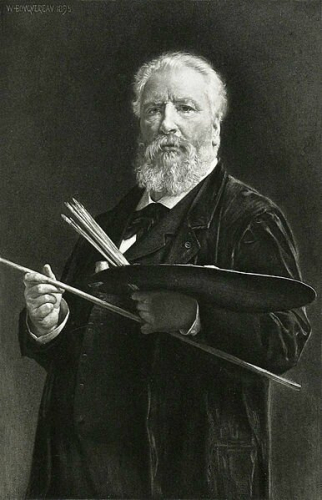
Émile Vernon was a French painter born in 1872. He trained at the École des Beaux-Arts in Paris, where he studied under William Bouguereau and Auguste Truphème. This academic education is reflected in the importance he placed on draftsmanship, the construction of figures, and the rendering of flesh tones.
He began exhibiting at the Salon des Artistes Français at the end of the nineteenth century and received an honorable mention there, attesting to the official recognition of his work. His career unfolded primarily in Paris, within the artistic context of the Belle Époque.
His œuvre is largely devoted to the representation of the female figure. He painted portraits, idealized figures, and intimate scenes, often accompanied by floral elements or set against simple backgrounds. His compositions emphasize balance, the softness of gestures, and a harmonious color palette.
Émile Vernon’s style belongs to the academic tradition, while incorporating a decorative sensibility characteristic of the late nineteenth century. Without aligning himself with the avant-garde movements, his work reflects the taste of his time for an elegant and serene portrayal of the female model. He also worked as an illustrator, an activity that complemented his painted production.
Émile Vernon died in 1920. His body of work remains representative of a transitional phase in French painting, situated between academic heritage and the decorative sensibility of the Belle Époque, without formal rupture or theoretical manifesto.
No artwork matches
93400 Saint-Ouen sur Seine