
Auguste Bachelin
( 1830-1890 )
Biography
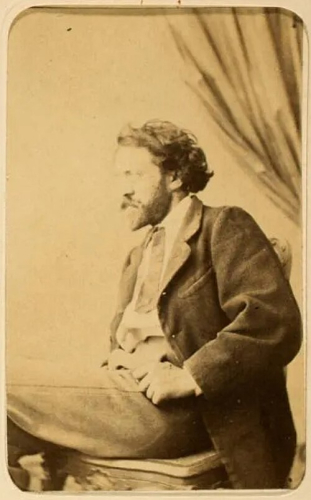
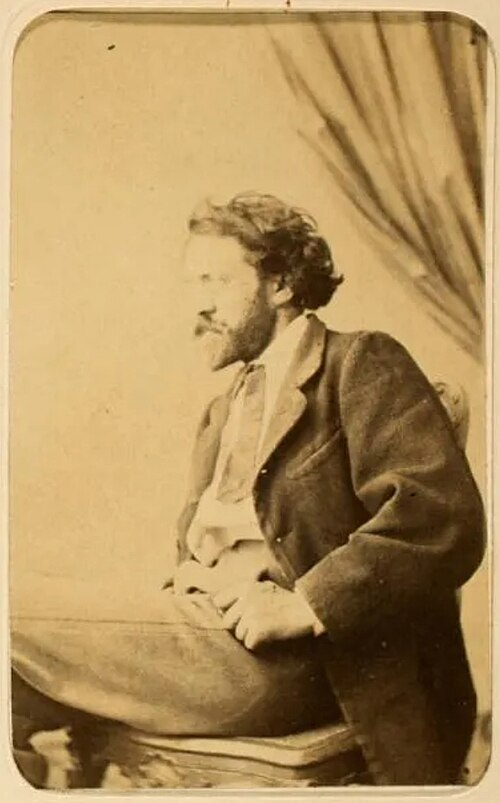
Swiss painter, illustrator, art critic, historian, and novelist Auguste Bachelin was born in Neuchâtel on September 30, 1830, into a modest family. The son of a cabinetmaker, he began his artistic training with the painter Louis Wallingre in Saint-Blaise, where he met Albert Anker, with whom he formed a lasting friendship.
In 1850, he left Switzerland for Paris and entered the studio of the Orientalist painter Charles Gleyre before continuing his studies under Thomas Couture. This transition from Swiss artistic training to the world of Parisian academic painting had a profound influence on his work. Bachelin developed a freer and more luminous style, particularly attentive to color and atmospheric effects.
For nearly twenty-four years, he divided his time between Paris and Switzerland, exhibiting regularly at the Paris Salon as well as at the Société des Amis des Arts de Neuchâtel. He painted Alpine landscapes, military scenes, genre subjects, and historical compositions, becoming an important figure in nineteenth-century Neuchâtel painting.
Deeply attached to Swiss cultural identity, Bachelin was also actively involved in intellectual and heritage circles. A founding member of the Société d’histoire et d’archéologie du canton de Neuchâtel, he helped establish the Musée d’art et d’histoire de Neuchâtel in 1885 alongside Alfred Godet. In parallel with his painting career, he published numerous articles, historical studies, and novels.
His work is distinguished by its luminous palette, sensitive brushwork, and strong interest in Alpine and lakeside landscapes. Both his genre scenes and mountain views reveal his fascination with natural light and with an idealized vision of nineteenth-century Switzerland.
Today, his works are held in several Swiss public collections, including the Musée d’art et d’histoire de Neuchâtel, the Musée des Beaux-Arts de La Chaux-de-Fonds, the Musée des Beaux-Arts du Locle, and the Landesmuseum Zürich.
He died in Bern on August 3, 1890, leaving behind a distinctive body of work at the crossroads of landscape painting, Alpine romanticism, and Swiss cultural identity.
No artwork matches
93400 Saint-Ouen sur Seine