
PUIGAUDEAU FERDINAND LOYEN
( 1864-1930 )
Biography
Born in Nantes on April 4, 1864, Ferdinand Loyen du Puigaudeau grew up in a comfortable environment, which allowed him to travel and train without following the traditional academic path. Largely self-taught, he developed an early passion for painting and, during the 1880s, became close to the artistic circles of Brittany.
His early work shows a strong interest in landscapes and scenes of Breton rural life. His encounters with painters such as Alfred Guillou and Talis Père in Concarneau, and later with the Pont-Aven circles, nurtured his sensitivity to light and color. Influenced by Impressionism and plein-air painting, he gradually developed a personal style in which chromatic vibration conveys shifting atmospheric effects.
In 1889, he traveled to Italy, where he discovered the great masters and refined his palette. Shortly afterward, he stayed in Venice—an experience that left a lasting mark on his work, fostering a taste for reflections, luminous effects, and the poetry of richly colored skies. Upon returning to Brittany, he painted ports, countryside, and above all the coastline, producing numerous studies of light at dawn and dusk.
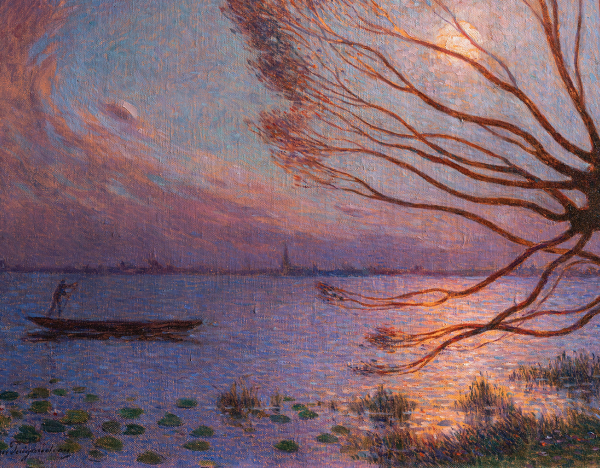
During the 1890s, he exhibited in Paris, notably at the Salon des Indépendants, and took part in exhibitions abroad. His work is distinguished by bold compositions and a particular attention to transparency and reflections. He favored isolated tree silhouettes, shimmering rivers, flamboyant sunsets, and nocturnal scenes illuminated by artificial light—especially fairground fires and electric lighting, still rare at the time. Living an independent life, sometimes away from major artistic centers, Puigaudeau settled in Batz-sur-Mer, where the Breton landscape provided an inexhaustible source of inspiration. His painting combines keen observation with poetic interpretation, earning him the recognition of discerning collectors.
He died on September 19, 1930, in Le Croisic, leaving behind a body of work in which light is always the true subject. His paintings, rare on the market, are sought after for the subtlety of their touch and the richness of their surface, bearing witness to an artist deeply rooted in Brittany yet open to the European influences of his time.
93400 Saint-Ouen sur Seine